In this age of automation and AI I enjoy the simple physical things where I can get them. Like finding a proper kanban card to help my work flow just-in-time.
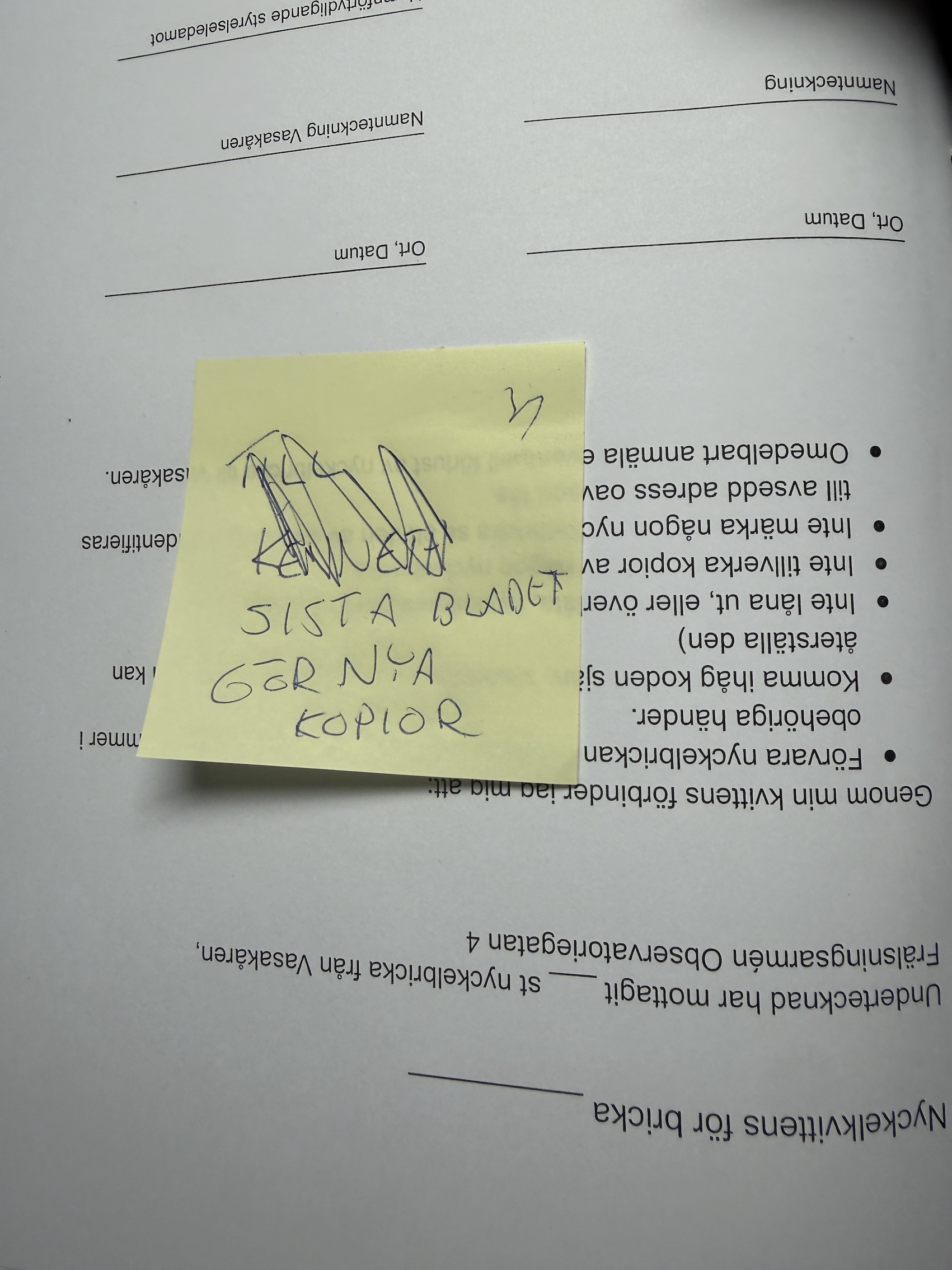
This post it was created by me about 2 years ago. It’s attached to the last sheet of a binder of key fob receipts in our Salvation Army Corps (church).
We are about 200 members in the church and many, but not all have a key fob (“blipp” in Swedish) to get into the church when it is locked. I am in charge of setting these people up in the system. Since there was about 100 people that wanted to get a fob I printed a bunch of blank templates and took one out for each receipt I wrote.
But then I got smart, read: my training kicked in. On the last copy I attached a sticker (that I reused - hence it said “To Kenneth” for another thing, I presume) that said “Last sheet - make new copies”.
Yesterday i got to that sheet. And as instructed I went to the copy machine and made 20 new templates. And move the sticky to the last sheet again, for the next time this happens.
Kanban
This is a real life Kanban card. Kanban is actually two Japanese words put together: kan - visual and ban - card.
This card is a signal to pull more work from an upstream source, just in time. In this case I had used up the copied templates and the card signaled to me that it was, right now, a good time to make new copies.
That’s what a Kanban card is. This simple little device, helps us to keep inventory low (I could have printed 200 copies, but that would have been wasteful) and get the work done just when it’s needed rather than just because it might be needed later.
Kanban and stuff
Kanban and pull systems have been used in Toyota and their Toyota Production System since … 50-ies at least. TPS is what we in the west call Lean. Since pull is at the heart of what they do the first signal starts with the end user (aka customer) of the product, meaning that makes the system value focused and customer oriented.
These principles were adopted by David J Andersson in the late 2000 (a book written in 2010) to form the Kanban Method to change an entire organization to be more lean, pull-oriented, less wasteful and more value focused. One of the more powerful stances that this evolutionary change approaches adopts is that it allows and encourage us to start where we are. Rather than to adopt someone else framework and do revolution to where they think it’s good to be.
Since digital (development) work happens mostly in our heads we need to make the work visible and a common way of doing that is to make each thing we work represented as a card (a kanban card) typically in a digital tool.
The kanban methods secret sauce is to have a limit on how many things we are working on at the same time. This creates a little tension in the system, since we now cannot start more work than the limit allows. Mixing in the concept of pull it also ensures that we focus on finishing work rather than keeping people busy.
So, in the words of Tobbe Gyllebring; when using (the) kanban (method) its good to keep the number of kanbans (cards) on your kanban board low.
Kanban means many things. But in essence it’s just a little card that instructs you when to do some work, just in time for when you need it. Simple and powerful.