I was just in a meeting where we rattled of a few basic features to build on top of a database. It sounded a bit like this:
- Ok - let them browse the projects by name
- And by tags, of course
- Sure, and probably filter by location
- Wouldn’t it be cool if they could see how many other companies in their industry have been involved in the projects in our database?
- Oh - and then, just for fun; let’s put an LLM in place so that they can chat with the data, so to speak.
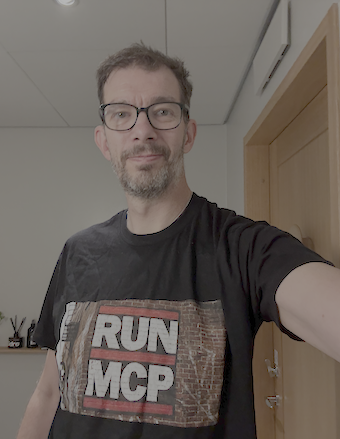
And at this point I just realized that the other features were now redundant. Because with our database hooked up to a LLM Chat that is operating on the data using an MCP server, all those questions would be possible to answer.
Are features not our main deliverable any more?
 Read More
Welding and punch cards
The paradigm shift that we are in is now real. I just realized how much my own world has shifted in what and how I do things at work, in less than a year. December 2025 was the first time I allowed an agent to write a feature from a prompt and felt safe that the result would be good enough to use.
I’ve been thinking about welding and punch cards - and that has helped me think more freely about where we are heading. And what my value will be in that world.
Read More
AI flow - it is cheap to run, not to learn
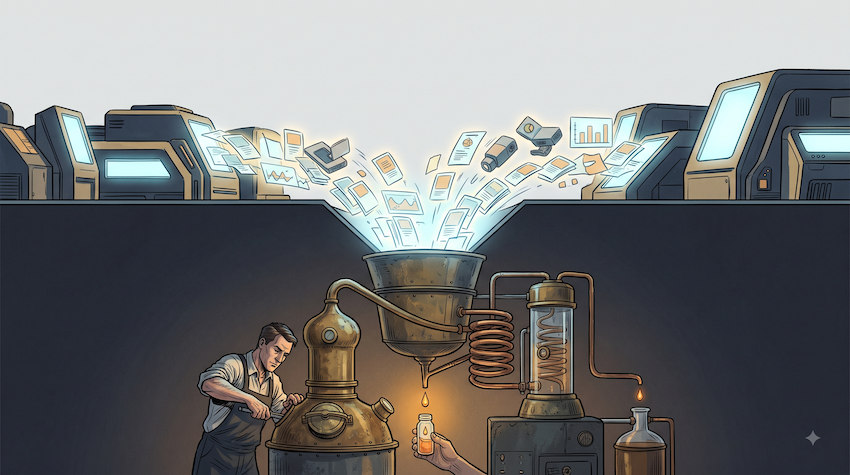
Since I started to see people use AI to build digital products something has always rubbed me the wrong way. It is like we are forgetting value, outcomes or impact and just keep clapping for the output. Token-maxing is real and I often have a hard time reaching through to people with this message, just because we are so happy that we close more (and bigger) pull requests.
Let’s not forget that. Let’s bring a value-obsessed, outcome measured and impact focused way of working back. Right now we are wasting the human capacity on keeping the agents busy.
I’ve written a few posts now on flow in the age of AI and to be honest, the other posts have been a setup to this post that is like the main idea (or itch I needed to scratch). Let me bring you...
Read More
AI flow - are we elevated? Or deskilled?
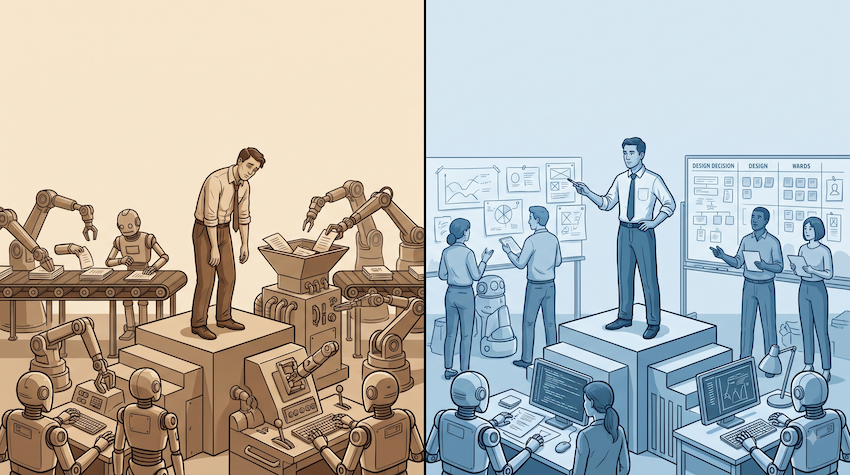
I’ve written a few posts on AI and how it changes the flow of value, looking at it using my Theory of Constraints glasses.
But are we really moving up in the value chain or is it actually deskilling and we end up baby-sitting an AI robot?
You can find them here, if you want:
But I had a few more things that I wanted to get out of my system. The first is the fact that with automation, such as robots, the workers moved up in the value chain. This is happening again now, as AI is being used to do much of the writing, creation and generation.
Read More
AI flow - Are AI our as robots? Hold on - haven't we been here before?
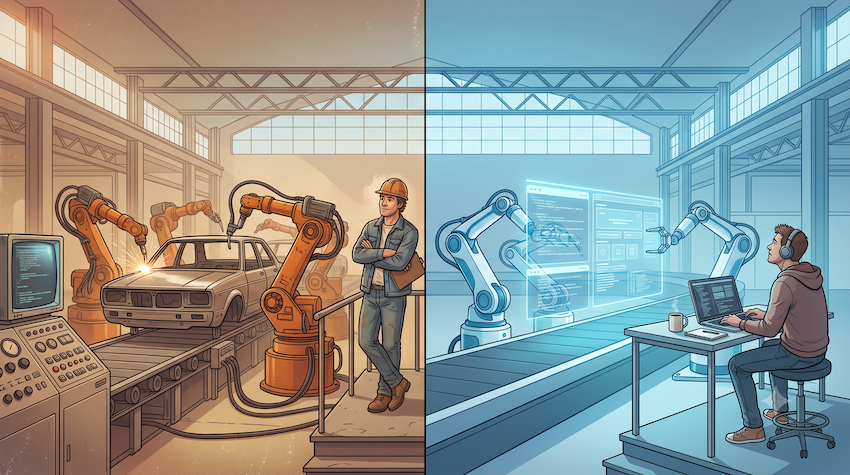
The revolution, well paradigm shift rather, we are experiencing in AI has a likening with how industrial robots made a paradigm shift in the manufacturing industry in the 80-ies. Both when it comes to how it was introduced, the fears it raised, the mistakes “we” did utilizing the power and how the winners ended up using them.
Now, I’m old but in the 1980-ies I was 10 years old and more interested in playing games on my Vic 20, soccer and riding my bike (yes, it was a simpler life). But I have read a lot about this topic since this was when Toyota started to blow the competition out of the water. Also, my all time favorite book The Goal (by Dr Eliyahu Goldratt) has the robot revolution as part of the driver of the story and the...
Read More
AI Flow - theory of constraints
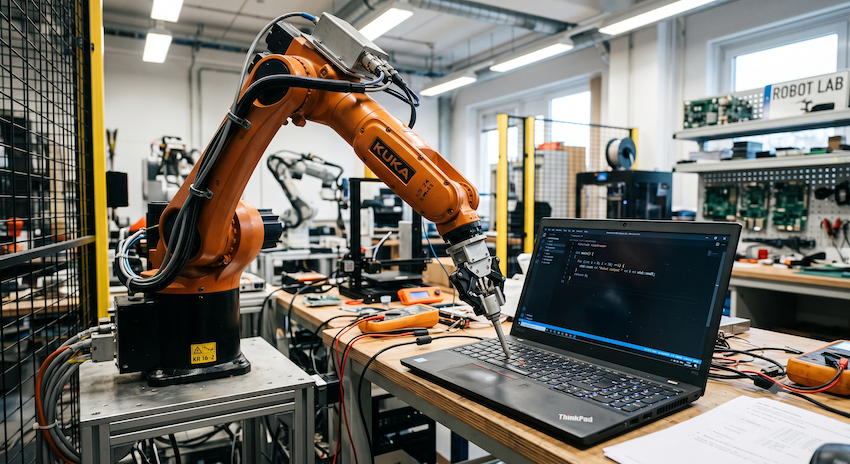
AI is arguably one of the biggest paradigm shifts in the digital product development industry ever. Even if it stopped right now with Fable 5, we still would have changed so much that the before feel like a distant past. Writing the code by hand? Please...
A discussion with a friend, that works in manufacturing industry, made me reflect over this paradigm shift. It reminds me a lot about the advent of industrial robots in the manufacturing industry. This was 1970-80 circa and these robots was also perceived as something that would make “ALL WORKERS REDUNDANT” and visions of fully automated factories was envisioned.
Early on the outcome was hard to forecast too; the industry robots did a lot of the manual work that humans used to do and did it much more reliable and better than humans. Also - the...
Read More
AI Flow - a thought on throughput
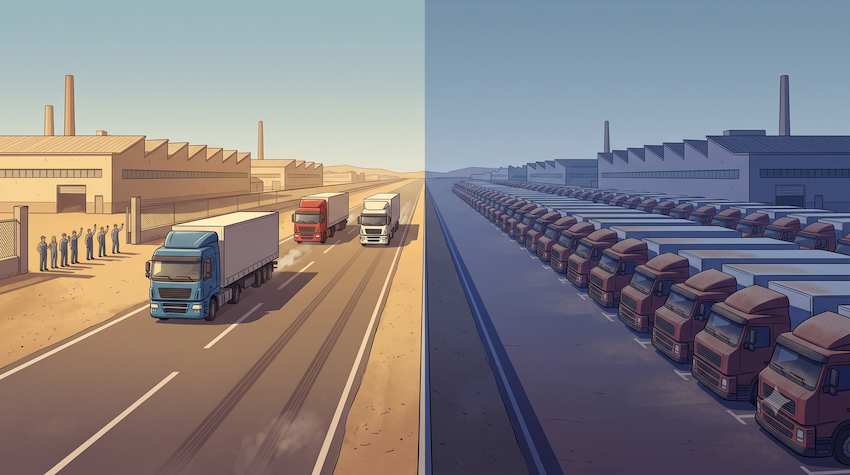
The world of digital product development has changed forever with the advent of AI models like Opus (that was the first to make me realize this). In fact, many other industries have also changed, but I’m going to stick with what I know.
And ever since I started to realize that code will be written by agents that instruct I immediately got a sense that we (the industry) are making age-old mistakes that we and other industries have made, fixed and now comes back to.
We are focusing a lot on the things that rubs me the wrong way; output, efficiency, velocity and productivity. None of those are bad per se but without knowing the goal, something about the value, stating effects impact etc… They become productivity theater
I realized that I hadn’t thought this through properly and decided to write a...
Read More
New LinkedIn profile ... story
Over the years I have grown tired of the tightness in how we talk about our jobs, achievements and careers in general at LinkedIn. I poked a bit of fun to it by writing a different type of profile section.
Being a Swede I find it really embarrassing toothing my own horn, so I made up a story about two friends that talks about me instead. And then another story where I was at trial before a judge. And then one where my grand grand grand children talked about me after the AI lords had taken over.
Now that last one, feels a bit dated so I decided to change it to a one where two sport commentator reads out my achievements and jobs.
All of these are handcrafted, non-AI-generated, text. Like we did back in the days.
Some serious reflection
I am amazingly...
Read More